



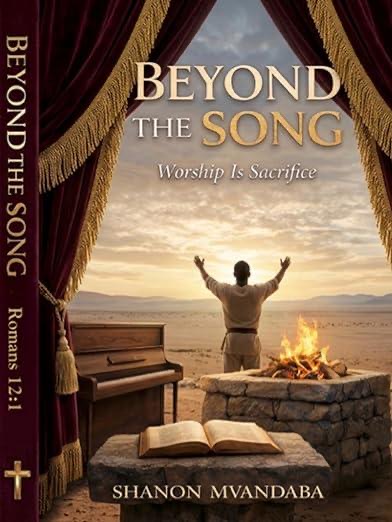
Why Shanon Mvandaba Believes Worship Is More Than Music
For many Christians, worship begins when the first song starts on a Sunday morning and ends when the service is over.
For Shanon Mvandaba, that’s only the beginning.
His new book, Beyond the Song: Worship Is a Sacrifice, was born from a question that lingered in his heart for years: What if worship is far more than music?
It’s a question that first challenged him before it ever became a message for anyone else.
“I realised there were moments when I was singing declarations that were not fully embodied in my own life,” he says. “That forced me to confront some uncomfortable truths about myself.”
Rather than pushing those questions aside, Mvandaba leaned into them. He began studying Scripture, reflecting on his own life and asking whether worship was ever meant to be confined to a few songs inside a church building.
The deeper he searched, the more he realised that worship wasn’t something reserved for Sundays.
It was something meant to shape every day.
That journey eventually became Beyond the Song.
One of the biggest shifts in his thinking came when he realised that worship isn’t simply a Christian practice—it’s part of being human.
“Every person worships something,” he says. “The question isn’t whether we worship, but what or whom we worship.”
It’s a simple statement, but one that sits at the heart of his book.
Whether it’s success, money, relationships, careers or recognition, Mvandaba believes everyone gives their devotion to something. His invitation is for readers to consider where God fits into that picture.
He also believes that somewhere along the way, many churches unintentionally narrowed the meaning of worship.
Music became the focus.
The experience became the measure.
But according to Mvandaba, worship was never supposed to end when the music does.
“When worship is confined to a musical moment, it becomes something we attend rather than something we embody.”
For him, worship shows up just as much in forgiveness, obedience, humility and everyday choices as it does in songs sung from a stage.
Ironically, writing the book became one of the biggest lessons of his own faith journey.
As he worked through each chapter, he found himself surrendering areas of his own life that still needed God’s attention—control, ambition, disappointment and old wounds.
“What begins as surrender eventually becomes freedom,” he says. “What feels like sacrifice often becomes the pathway to deeper intimacy with God.”
What makes Mvandaba’s story refreshing is that he never claims to have had everything figured out.
Quite the opposite.
“I embarked on this journey because I was carrying questions that I could not ignore.”
Those questions became the very thing that shaped the book.
Instead of presenting himself as someone with all the answers, he simply invites readers to begin asking better questions of their own.
Beyond the Song Answer for Magazine .pdf
At a time when so many people are searching for purpose and identity, he believes the answer isn’t found in achieving more but in returning to the One who created us.
“We were made by God, for God. Because our origin is in Him, our deepest fulfilment is found in Him.”
It’s a message he hopes resonates with anyone who has ever felt spiritually tired, disconnected or uncertain.
“My hope is that readers come to see worship not simply as something we do, but as a lifelong journey,” he says. “The goal isn’t just to become better worshippers. It’s to become people whose lives reflect the One we worship.”
Beyond the Song Answer for Magazine .pdf
Looking back, Mvandaba admits there were seasons when it felt like life was moving forward for everyone else while he remained in preparation.
Today, he sees those years differently.
“God is more concerned with who we are becoming than with how quickly we arrive.”
It’s a lesson that quietly runs through every chapter of Beyond the Song.
Ultimately, Mvandaba isn’t hoping readers simply finish his book.
He’s hoping they pause, reflect and perhaps begin looking at worship—and their own lives—from a completely different perspective.
Because maybe worship doesn’t begin when the music starts.
Maybe it begins with surrender.