



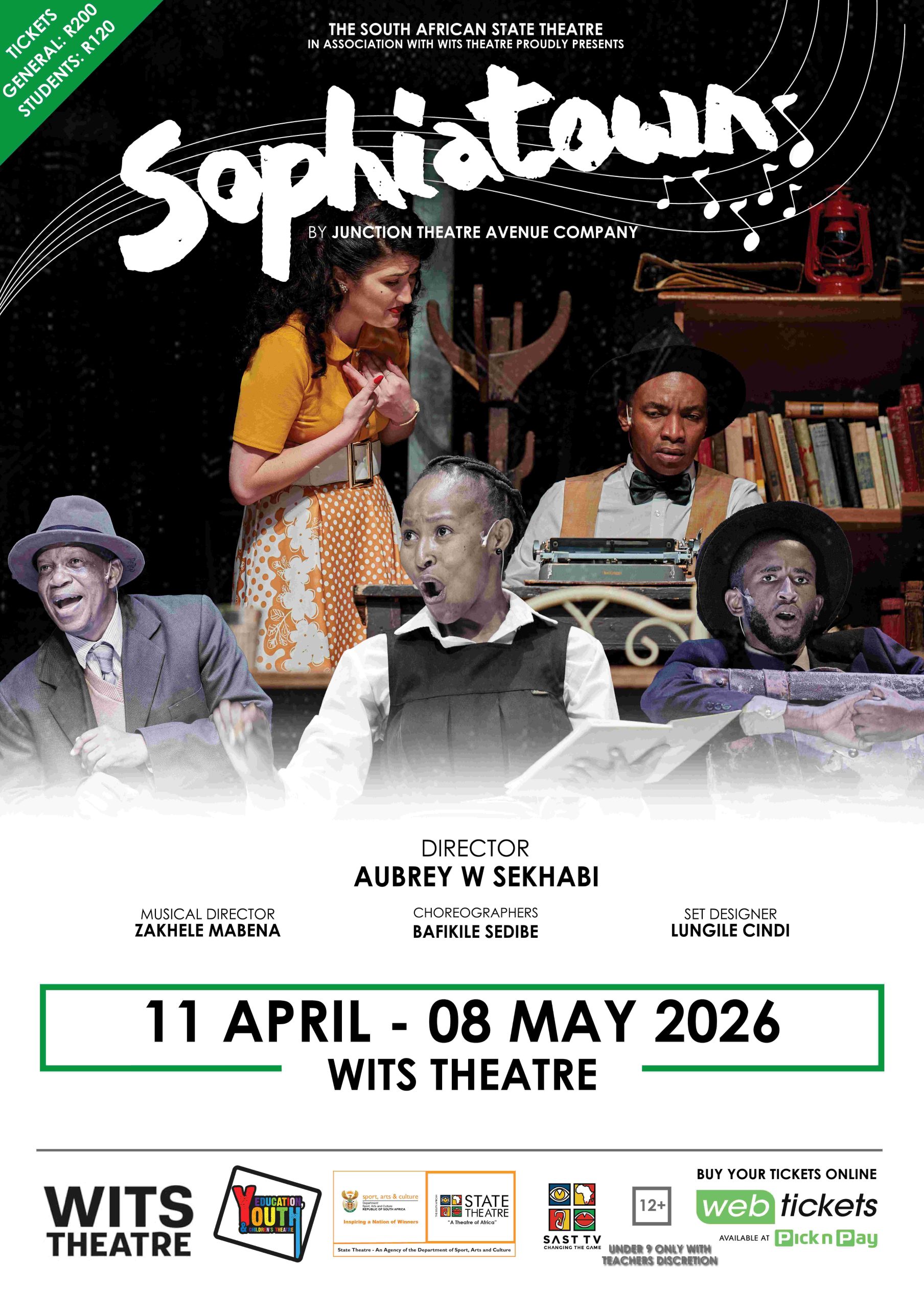
South African Classic Sophiatown Returns to the Stage with a Bold New Generation of Performers
One of South Africa’s most iconic theatre productions, Sophiatown, returns to the stage in a vibrant revival that brings the legendary story of Kofifi to life for a new generation of audiences. The production forms part of a dedicated schools’ programme, with special daytime performances available for school groups and curriculum-linked bookings across the Wits Theatre schools network. The production will run from 11 to 24 April and from 5 to 8 May 2026.
Under the experienced direction of award-winning playwright and director Aubrey Sekhabi, the production introduces a fresh young cast who will step into one of the country’s most beloved theatrical works – a powerful drama infused with music that captures the spirit, struggle and cultural brilliance of the historic Johannesburg suburb.
Once known as the “Chicago of South Africa”, Sophiatown was a place where shebeen queens, gangsters, journalists, musicians, politicians and bohemian artists rubbed shoulders in a neighbourhood alive with jazz, politics, style and rebellion. During the 1940s and 1950s, this vibrant community became a crucible of urban African culture, producing some of South Africa’s most influential writers, musicians and political thinkers.
The play imagines one remarkable story from that time.
A group of journalists share a house in the bustling suburb and place an advert for a new housemate. Despite the strict apartheid laws of the era, they receive permission for a white Jewish woman, Ruth Golden, to move in with them. When she arrives at the doorstep of the fiery journalist Jakes, suitcase in hand, the household and neighbourhood is confronted with the complex realities of race, identity and belonging in a society built on division.
The story unfolds against a backdrop of a’capella harmonies and songs drawn from the era, evoking the music and rhythms of Sophiatown (or Kofifi, as it was affectionately known).
Despite the poverty and violence that marked the area, Sophiatown became a legendary cultural hub and epicentre of jazz, blues and political debate. It symbolised a rare space of freedom where people of different races lived, created and socialised together in a direct challenge to apartheid’s rigid system of racial segregation.
Its destruction by the apartheid government remains one of the most painful acts of forced removal in South African history.
Yet the story of Kofifi and its cultural legacy continues to resonate.
Director Aubrey Sekhabi, Artistic Director of the South African State Theatre and one of the country’s most respected theatre makers, says the revival honours the original text while allowing a new generation of artists to breathe fresh life into its characters and music.
“Sophiatown is actually a drama with music rather than a traditional musical,” says Sekhabi. “The script is so rich that even without the songs it would remain a powerful play. My aim has been to remain faithful to the text while allowing young performers to bring their own energy and interpretation to this extraordinary story.”
Sekhabi adds that working with young artists has been both a challenge and a joy.
“They approach the material with openness and curiosity. Giving emerging actors and designers the opportunity to engage with a South African classic like this allows them to connect with our cultural history while shaping its future.”
Playwright Professor Malcolm Purkey, one of the creators of the original work, believes the story remains as relevant today as when it was first staged.
“Sophiatown is more than a place. It is a symbol of the creativity, resilience and complexity of South African society,” says Purkey. “The play reminds us that even in the most oppressive times, people found ways to live together, create art and imagine a different future,” he says.
As South Africa continues to grapple with questions of identity, land, inequality and social cohesion, Sophiatown remains a powerful reminder of both the country’s turbulent past and the cultural brilliance that emerged from it.
Blending storytelling, music and history, this revival invites audiences to step back into the world of Sophiatown, a place where jazz drifted from shebeens late into the night and where the dream of a different South Africa once felt possible.
Venue Information
Wits Theatre, University of the Witwatersrand
Parking is available via the Station Street entrance (off Jorissen Street) after 17h00.
For daytime shows, visitors should park at the Anglo Dome visitor parking on Yale Road.
Uber drop-offs and pedestrian access are via Sutton Close entrance, where visitors will be required to scan their ID to enter campus.
Accessibility:
Wheelchair access is available, including ramps and elevators.
Refreshments:
Refreshments are available at the venue.
House Rules:
No cameras or recording devices are permitted inside the theatre except for authorised personnel.
Age Restriction:
16+
Dates:
11 to 24 April and 5 to 8 May 2026
Bookings & Enquiries
Tickets for the public are available through Webtickets. Schools wishing to make group bookings are encouraged to contact Kabelo Pakwe directly to arrange block bookings for learners and educators.
For group and block bookings – Kabelo Pakwe
kabelo.pakwe@wits.ac.za
011 717 1302